GEOTECHNICAL ENGINEERING
HAMPTON VIRGINIA
HomeGround improvementStone column design

Stone Column Design for Coastal Virginia Soils

Rigorous testing. Clear reporting.

LEARN MORE

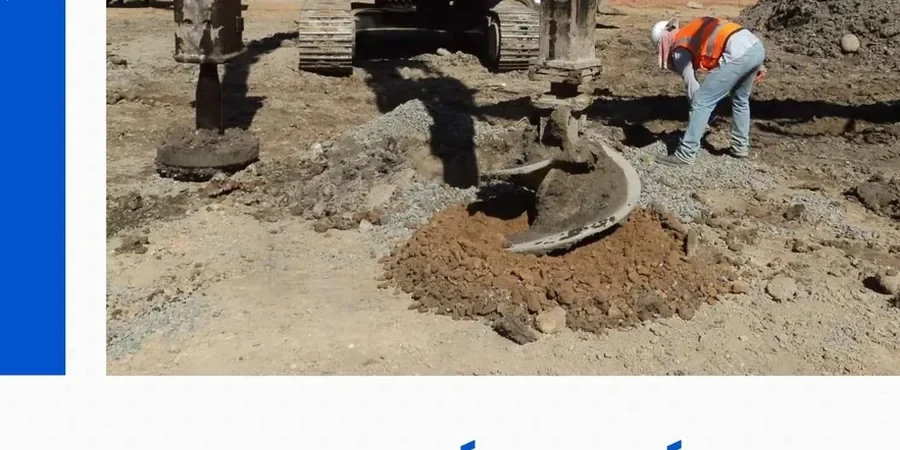
A four-story mixed-use project off West Pembroke Avenue hit a wall during excavation: twelve feet of soft, highly compressible silty clay with organic content typical of the Tidewater coastal plain. The structural engineer had already sized the footings assuming stiff subgrade, but the boring logs told a different story. Hampton sits on the Yorktown Formation and overlying Quaternary sediments deposited by the James and York river systems, and when the water table sits less than five feet below grade—as it does across much of the city's 136 square kilometers—conventional over-excavation becomes a costly gamble. Stone column design offers a ground improvement path that reinforces the weak zone from the bottom up, increasing composite shear strength while creating a drainage network that accelerates consolidation. Before committing to deep foundations, the project team paired a CPT test to map the soft layer continuously with a triaxial shear program on undisturbed samples to calibrate the area replacement ratio needed for the column grid.

A well-designed stone column grid can cut total settlement by half compared to untreated ground—provided the area replacement ratio is calibrated to the actual consolidation curve of the native soil.

Our service areas

Our approach and scope

A mistake repeated across Hampton Roads jobsites is specifying stone columns by diameter alone without tying the design to a quantifiable settlement-reduction target. A column grid is not a pile group; its performance depends on the stiffness ratio between the compacted gravel and the native matrix, and that ratio shifts with confining pressure as the surrounding soil consolidates around the column. The design workflow we apply starts with the Priebe method, extended by the incremental settlement approach from Raithel & Kempfert, to iterate on area replacement ratio, column spacing, and gravel friction angle until the predicted post-treatment settlement meets the structural tolerance. The gravel must be clean, angular, with less than five percent fines—ASTM D2487 governs the gradation—and the installation method, whether wet top-feed or bottom-feed vibro-replacement, determines the final column diameter achievable in Hampton's silty-clay overburden. For sites where the soft layer transitions to loose sand at depth, we often integrate findings from an SPT drilling program to verify that the bearing stratum below the treatment zone can carry the redistributed column load without punching shear failure.
Stone Column Design for Coastal Virginia Soils
Technical reference — Hampton Virginia

Site-specific factors

One condition we see repeatedly in Hampton projects is the temptation to treat stone columns as a plug-and-play solution without running a post-installation CPT verification grid. Columns can neck in soft zones, gravel can intermix with organic silt if the vibroflot withdrawal rate is too fast, and the actual diameter frequently deviates from the design diameter by ten to fifteen percent—enough to throw the settlement prediction off by a third. The IBC mandates that ground improvement designs account for the design earthquake, and in Seismic Design Category C or D sites east of Interstate 64, the column grid must remain stable under the reduced effective stress that accompanies cyclic pore pressure buildup. A liquefaction assessment becomes essential when the treatment zone extends into saturated loose sands below the clay layer, because stone columns provide both densification and drainage, but the spacing must be tight enough to dissipate excess pore pressure before it triggers a strength loss in the inter-column soil.

Need a geotechnical assessment?

Reply within 24h.

Email: [email protected]

Regulatory framework

ASTM D2487 – Unified Soil Classification for gradation specification of column aggregate, ASCE 7-22 – Minimum design loads for buildings, including seismic compatibility of ground improvement, IBC 2021 – Acceptance criteria for ground improvement in Seismic Design Categories C and D, FHWA-NHI-16-027 – Ground Improvement Methods, Vol. I and II, reference for Priebe and Raithel-Kempfert methods

Reference parameters

ParameterTypical value
Area replacement ratio (A_s/A)0.10 – 0.35 typical for coastal silty clays
Column diameter (installed)0.60 – 1.20 m depending on vibro-displacement equipment
Gravel friction angle (phi_prime)38° – 42° for clean angular limestone or granite aggregate
Settlement reduction factor (n_0)2.0 – 4.5 for normally consolidated Hampton clays
Target post-treatment undrained shear strength40 – 80 kPa composite, verified by CPT before construction
Design standardFHWA Ground Improvement Manual; ASCE 7-22 for seismic compatibility
Drainage improvementRadial consolidation coefficient (c_r) increases 3x to 10x over untreated soil

Common questions

How much does stone column design and construction cost for a typical Hampton commercial lot?

For a commercial building footprint of 3,000 to 8,000 square feet in Hampton, design fees and installation typically fall between US$1,640 and US$5,090 depending on the depth of the soft layer, the number of columns required, and the accessibility for vibroflot equipment. Projects with very deep organic deposits or tight column spacing will lean toward the upper end of that range.

When are stone columns a better choice than deep foundations in Hampton's soils?

Stone columns become competitive when the soft layer is less than 30 feet thick, the structure can tolerate an inch or two of post-treatment settlement, and the column grid can be installed without excessive groundwater control costs. For lightly loaded slabs-on-grade or low-rise buildings on the Yorktown Formation's compressible silts, columns often avoid the cost and schedule impact of driving piles through the same material.

Does the Hampton building department require a special inspection for stone column work?

Yes. Under the IBC, ground improvement falls under special inspection requirements. The Hampton Department of Community Development will expect a statement of special inspections identifying the verification method—typically post-installation CPT soundings—and the responsible geotechnical engineer of record must submit the acceptance report before the foundation permit is closed out.

What aggregate specification works best for stone columns in coastal Virginia clays?

ASTM D2487 governs the gradation; we specify a clean, angular crushed stone—usually #57 or #67 gradation—with less than five percent passing the No. 200 sieve. The aggregate must be hard, durable limestone or granite with a Los Angeles abrasion loss below 40 percent. Rounded gravel reduces interlock and lowers the friction angle, which directly reduces the settlement improvement factor.

Location and service area

We serve projects in Hampton Virginia and surrounding areas.

View larger map