GEOTECHNICAL ENGINEERING
HAMPTON VIRGINIA
HomeLaboratoryAtterberg limits

Atterberg Limits Testing in Hampton Virginia for Foundation Design

Rigorous testing. Clear reporting.

LEARN MORE

A few years back, we were called out to a site near the Hampton Coliseum where a three-story office building had developed serious drywall cracks just 18 months after construction. The original geotech report based foundation design on a single boring with basic classification, but nobody had run Atterberg limits across the full depth of the silty clay stratum. When we sampled at 6 and 10 feet, the liquid limit jumped from 42 to 68 and the plasticity index nearly doubled. That kind of variation is typical of the Yorktown Formation deposits that underlie much of this city, and missing it means differential movement that standard bearing capacity checks will never catch. Hampton sits right where the coastal plain meets the Chesapeake Bay estuary at roughly 37 degrees north latitude, so we get marine clays interfingered with fluvial silts, and the plasticity profile can shift dramatically within a single block. We now insist on Atterberg limits at every major stratum change when working within three miles of the Hampton Roads shoreline.

Plasticity index above 25 in Hampton's Yorktown clays demands we rethink foundation depth, not just bearing capacity.
Our service areas

Our approach and scope

The most common mistake we see local contractors make is assuming that a soil that looks 'clayey' in the field has uniform behavior throughout the year. Hampton's water table sits high, often within 4 to 7 feet of grade in neighborhoods like Fox Hill and Wythe, and the seasonal wet-dry cycles push silty clays right across the plastic limit threshold repeatedly. A sample that feels stiff in August can turn to putty by February.

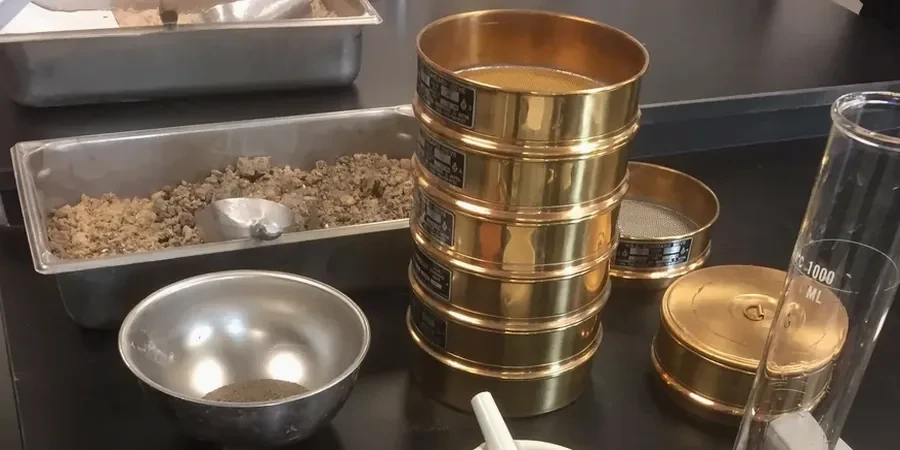
Atterberg limits testing under ASTM D4318 gives us three numbers that define the boundaries of that behavior: the liquid limit, the plastic limit, and the plasticity index. In our lab we run the multipoint liquid limit method rather than the one-point shortcut, because Hampton's marine clays often contain enough organic fines to throw off the single-point correlation. For the plastic limit we roll threads to 1/8 inch diameter at a moisture content where the thread just begins to crumble. The difference between those two water contents gives the PI, and when it exceeds 25 in a soil with more than 40 percent passing the No. 200 sieve, we start having serious conversations about moisture-conditioned excavation and extended footing embedment.

We also look at the liquidity index on undisturbed samples. A liquidity index above 0.8 means the in-situ soil is close to its liquid limit, which is exactly the condition we found beneath a warehouse slab on Aberdeen Road after a broken water line saturated the subgrade for six weeks. The standard proctor compaction curve becomes meaningless when the natural water content is that high relative to the Atterberg boundaries.
Atterberg Limits Testing in Hampton Virginia for Foundation Design
Technical reference — Hampton Virginia

Site-specific factors

The soil profile changes fast across Hampton. Out toward Buckroe Beach and the salt marshes, you get organic silts with liquid limits above 70 and natural water contents that run 50 to 80 percent. Those soils are barely above their plastic limit half the year, and a shallow footing in that material behaves more like a raft on mud than a rigid foundation element. Compare that to the higher ground near the NASA Langley Research Center, where weathered Yorktown silts have a PI in the 12 to 18 range and behave reasonably well under load. The risk isn't in any one number; it's in designing for one part of town using assumptions from another. We've seen foundations fail inspection when the PI jumped from 14 to 38 across a 3-foot vertical change and the excavation wasn't deepened accordingly. Hampton's seismic design category per IBC maps to Site Class D or E depending on the upper 100 feet, and the plasticity index feeds directly into that classification via the average undrained shear strength correlation. If you skip Atterberg limits and just run grain size, you miss the behavior that actually governs settlement rate and heave potential.

Need a geotechnical assessment?

Reply within 24h.

Email: [email protected]

Watch the video

Regulatory framework

ASTM D4318-17e1, ASTM D2216, IBC 2021 (Site Class determination via Chapter 16)

Reference parameters

ParameterTypical value
ASTM StandardD4318-17e1 (multipoint liquid limit)
Liquid Limit DeviceBrass cup, grooving tool, 2mm closure at 25 blows
Plastic Limit Thread1/8 inch (3.2 mm) diameter at crumbling
Plasticity Index Range (Typical Hampton)8 to 45 (clean silts to fat clays)
Sample Mass Required150 g minus No. 40 sieve
Oven Drying110 ± 5°C per ASTM D2216
Reported ValuesLL, PL, PI, Liquidity Index (if natural w% provided)

Common questions

How much does Atterberg limits testing cost in Hampton VA?

For a standard liquid limit and plastic limit pair on a single soil sample, pricing runs between US$50 and US$90 depending on whether you need the multipoint liquid limit or the one-point correlation. A full classification package with grain size, Atterberg, and organic content on the same sample typically falls in the US$120 to US$180 range. We provide firm quotes once we know the number of samples and the turnaround you need; same-day and 24-hour results are available for an expedited fee.

What sample size do you need for Atterberg limits testing?

We need about 150 grams of material passing the No. 40 sieve for a complete liquid and plastic limit determination. That usually means sending us a bagged sample of roughly 500 grams of bulk soil so we have enough to split out the minus-40 fraction and still run a moisture content and, if requested, a grain size distribution. For Shelby tube samples from Hampton's Yorktown clays, a 4- to 6-inch segment from the zone of interest is sufficient.

Why does my Hampton project need Atterberg limits if I already have a grain size report?

Grain size tells you the percentage of clay and silt; Atterberg limits tell you how that fine fraction actually behaves with changes in water content. Two Hampton soils can have identical clay percentages but vastly different plasticity because of mineralogy. The smectitic clays found in parts of the Yorktown Formation produce PI values above 30 even at low clay content, while kaolinitic soils from weathered upland deposits might show PI below 15. Without Atterberg data, you don't know whether your foundation will heave, shrink, or remain stable through Hampton's wet-dry seasonal cycles.

Location and service area

We serve projects in Hampton Virginia and surrounding areas.

View larger map